Mindfulness and the Art of Turning Off the Fire Alarm: A Guide to Managing Stress
Introduction: Ah, Fall. A Confession from a Recovering Overthinker
Ah, Fall. The time of year spent in screaming terror at the upcoming winter barely numbed by the pumpkin spicy sweetness coating my tongue. I wanted to take some time to write about something that I am both decidedly not an expert in and have a deep passion for.
In a brief nod to the lapsed faith of my childhood, I have a confession to make. I’m a recovering overthinker. I have some sense that thinking was a tool that helped me survive my early life, serves me well in my profession, and helps me navigate the world. AND it’s a double edged sword that can cut me off from myself.
Stress management 101
Something in your life happens, and provokes a stress response.
If you’re really connected to what’s happening in the moment you might notice:
- That your breath changes
- That muscles around your neck and face tighten
- That you experience some kind of sensation through your chest and abdomen.
And if you’re like me 5 years ago, you might not experience any of this, because you’re so gosh darn good at solving problems that your mind runs away trying to find a solution.
The only downside to this strategy is that the very moment you noticed that you had a problem that provoked your stress response, you got yourself a second “problem”, your stress/emotional response itself.
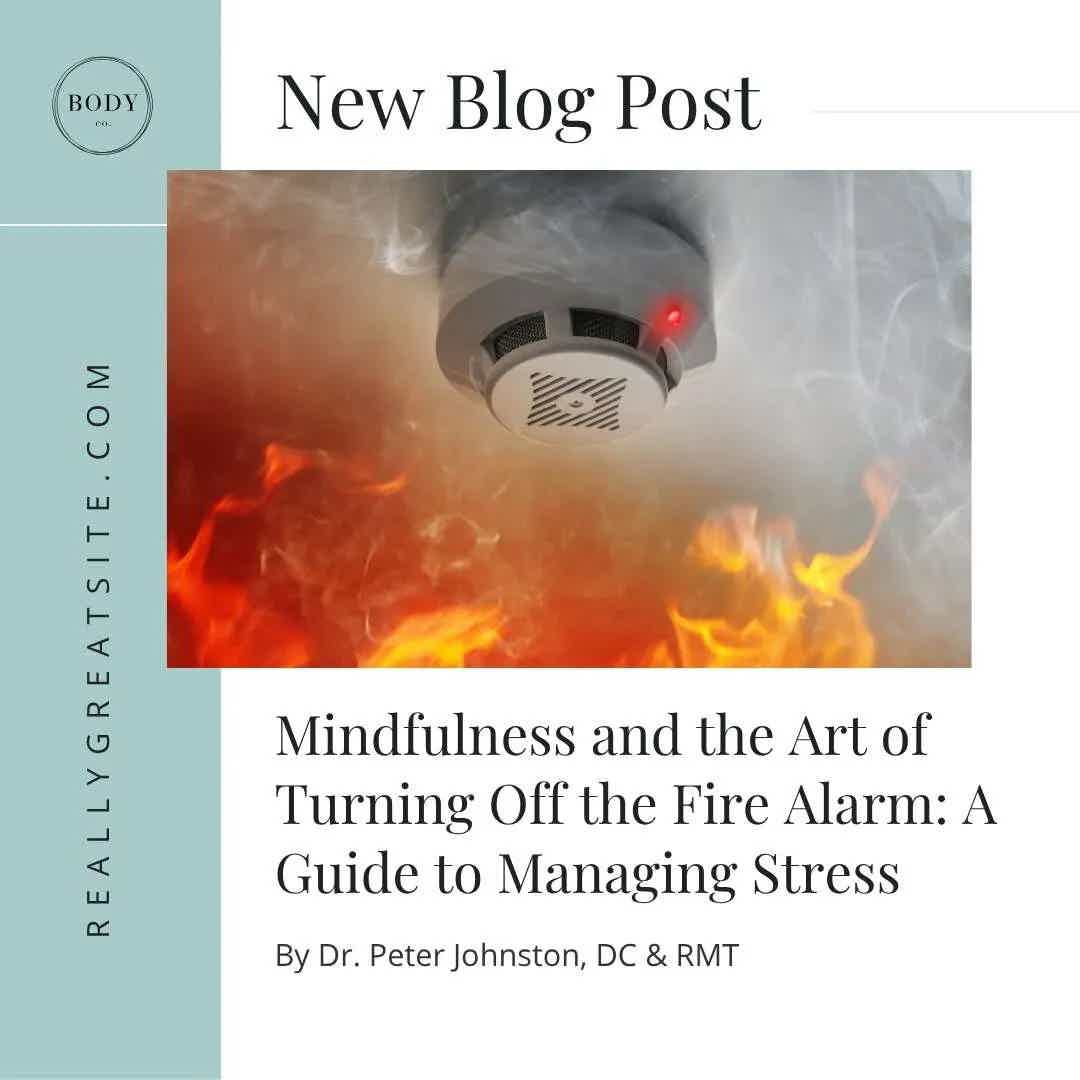
I like to think of this with a firefighting analogy:
- The fire = The inciting incident (something that needs solving).
- The alarm = Your body's stress signal.
Eliminating the fire is not always sufficient stimulus to turn off the fire alarm.
Turning off the fire alarm.
Emily Nagoski’s Come as You Are offers 10 evidence-based ways to reduce the stress that’s built up inside of your system
- Exercise
- Laughter
- Breathing
- A hug that’s “long enough”
- Creative expression
- And more
These strategies are important to blow off the steam of a lifetime of unattended to alarm signals.
They can be really useful when your stress is acute in a way that makes seem impossible to attend to yourself. It has been my experience that bringing your attention back to your current experience is the most effective way to turn off the alarm in the moment.
It does take ~10ish minutes for the alarms to fully reduce, and the experience of this, if you’re not used to it, can be rather intense.
Analogy: Sitting in your raw emotional/physical experience for the first time can feel obliterative and overwhelming.
Imagine trying to drink tea that’s so hot that the entirety of the tea immediately bursts into steam. As you drink:
- The "tea" (your stress) cools.
- It’s still deeply unpleasant, but it's tolerable.
- Over multiple iterations, you start to notice the subtle aromatics — the nuance — that were invisible before.
Something more Pragmatic
If you’ve recoiled a bit reading this — fair enough! Diving into raw self-experience is an undertaking that needs time, safety, and support.
Let’s turn to neuroscience to bridge the gap.
There’s an idea in the karmic traditions that thinking exists to protect us from feeling.
Modern research supports this — showing that the more active the narrative (thinking) parts of our brain are, the less active our emotional and bodily perception circuits become.
Think about how easy it is to get lost in thoughts — and how rare it is to get lost in pure experience or feeling.
The good news: this suppression isn’t binary, it’s scalar.
By thinking less or thinking in a way that integrates body and emotion, we can still keep some emotional protection while learning to turn off the fire alarm.
The Skill: Observing Thought Layers to Reconnect with the Body
Here’s a skill that helped me at the start of my mindfulness journey.
If you’re not great at noticing your body, notice your thoughts instead.
The number of layers of interpretation between you and your raw experience indicates how much you’re thinking — and suppressing your bodily awareness.
Example of Abstraction Levels
- No abstraction: I notice your mouth move, and notice a warmth in my chest.
- Level 1: I notice your mouth move and imagine you're smiling.
- Level 2: I notice you smiling and know that you're happy.
- Level 3: You’re smiling because you're happy with what I said.
- Level 4: You’re smiling because what I said reminded you of (x) element in your past.
- Level n: You vote for x so you must hate y.
All of these could be true.
For the sake of mindfulness practice, when you notice a complex thought with multiple layers of abstraction:
- Ask yourself what you can know to be true.
- If you’re with someone safe, ask questions about your assumptions.
- Notice what’s correct and what’s not.
Undermining your mind’s certainty can be a valuable way to loosen your grip on thoughts and return to embodied awareness.
Reducing the amount you “think” allows you to have more of a bodily experience, which helps your stress cycle complete.
Final Thoughts: Evidence-Based Mindfulness and Local Resources
Mindfulness is an evidence-based strategy for:
- Stress reduction
- Pain reduction
- Emotional regulation
When I began this work, connecting with peers and having formal training was invaluable.
If this exploration resonates, consider enrolling in a Mindfulness-Based Stress Reduction (MBSR) program.
These 8–10 week programs teach:
- The nature of anxiety and stress
- Tools to manage them
- A stepwise approach to integrate awareness into daily life
There are OHIP-covered and private options available.
OHIP-Covered Programs (Toronto)
- NeuroNova Centre: Specialized MBCPM™ for chronic pain, 4–12 month wait — (416) 461-4333 – [neuronovacentre.com]
- North York General Hospital: MBSR groups, $350 materials fee — (416) 756-6671
- Sinai Health System: MBSR groups, minimal materials fee — (416) 461-8252
- St. Joseph's Health Centre: 10-week MBRP program, no cost — (416) 530-6000
University and Professional Training
- University of Toronto: MBCPM™ Facilitation Certificate for healthcare providers
- Meditation for Health: Dr. Lucinda Sykes, trained by Jon Kabat-Zinn — (416) 413-9158
Community Programs
- Miles Nadal JCC: MBSR $200–405 for non-members — (416) 924-6211
- The Mindfulness Clinic: $975 for 8-week groups — (416) 847-7118
- Centre for Mindfulness Studies: Free drop-ins, $520 programs with bursaries
Buddhist Meditation Centres (Free or Donation-Based)
- Shambhala Meditation Centre: Free weekly meditation — 670 Bloor St W, (416) 588-6465
- Bodhi Meditation Toronto: Free Saturday sessions — 180 Yorkland Blvd
- Toronto Zen Centre: Welcoming Zen environment — [torontozen.org]
- Mahamevnawa Buddha Meditation Centre: Free traditional teachings — [mahamevnawa.ca]
Immediate Access Programs
- Toronto Mindfulness Community: Free Friday classes — [torontomindfulnesscommunity.org]
- YogaMeditation Canada: Free drop-in classes, multiple GTA locations
- Davenport-Perth Community Health Centre: Free 8-week MBRP — (416) 656-8025
Online Resources
- UCSD Centre for Mindfulness: $575 MBSR programs with financial assistance — [ucsd.edu/mindfulness]

Meet Peter
Peter is a graduate of the Canadian Memorial Chiropractic College, University of Toronto and Kikkawa College. In practice since 2005, he has extensive experience with athletic populations from junior to masters, including working with the National Canadian Diving team, triathletes, runners, racquet sports athletes, dancers and all people that move to live a good life.
Having experienced injuries and chronic pain during his own athletic career, Peter has experienced how disabling common sports and occupational injuries can be. Realizing that the most disabling aspect of pain can be the lack of confidence and guidance on how to restore normal movement, Peter’s vision for the practice of orthopaedic healthcare is the use of therapy, education and advice to make sure that every patient can move without pain or fear.
Peter is certified to use medical acupuncture as an evidence-based Chiropractor and Registered Massage Therapist. His treatments include comprehensive education, spinal and extremity manipulation, soft tissue therapy, medical acupuncture, tailored exercise programs and healthy lifestyle modifications.